
 МИ ПРАЦЮЄМО ДЛЯ УКРАЇНИ
Table of Contents
- Is it worth trusting Google Ads automated bidding algorithms?
- How AI makes decisions for you
- When automation becomes dangerous
- Comparison of the main system operating models
- Why you shouldn’t handle the settings yourself
- Outsourcing Team: Why it’s better to trust professionals
- Questions that concern owners (FAQ)
- Conclusion
Is it worth trusting Google Ads automated bidding algorithms?
You can trust automation in Google Ads, but only if your advertising campaign already has a history of success. If your site consistently receives 30+ orders per month and every client action is correctly tracked by the system, artificial intelligence will work more effectively than a human. It analyzes the buyer’s time, location, and intent much faster. However, if you are just starting a business or trying to set everything up yourself without deep knowledge, the algorithm may spend money on overpriced clicks that don’t bring profit. You should only trust the system when you clearly understand the rules of its “learning” process.
How AI makes decisions for you
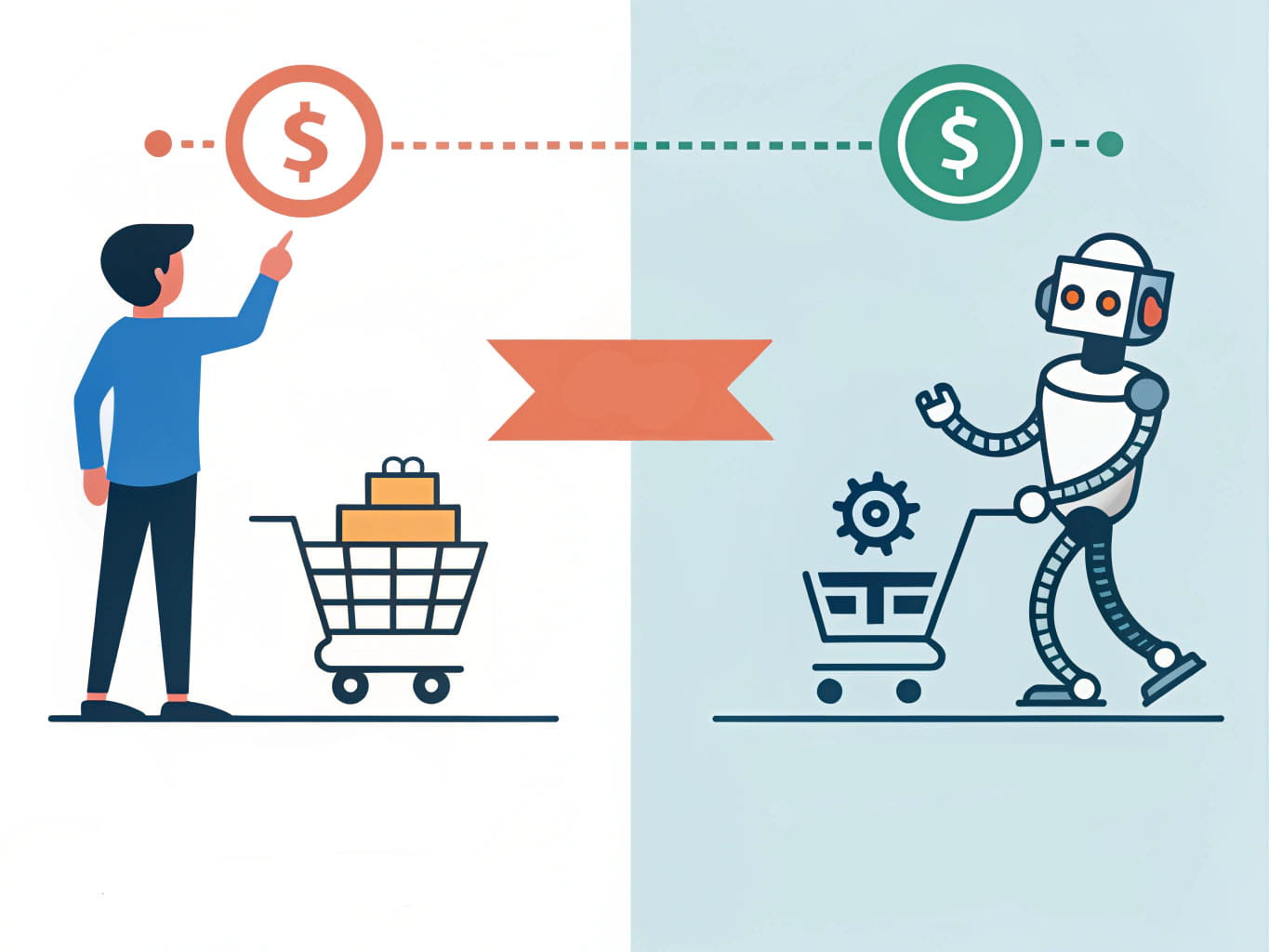
When you use Google Ads automated strategies, you allow the system to analyze millions of small details at the moment of every search query. The algorithm sees which phone the user is using, whether they searched for similar products before, and even how likely they are to make a purchase at that specific time of day.
Jerry Dischler, former VP of Google Ads, noted that the system considers all contextual factors, including device, language, and the user’s history of interaction with brands. This allows it to set a higher price where the probability of an order is maximum and save on those who are just “browsing” the web.
When automation becomes dangerous
The main problem is that a computer doesn’t understand your business as well as you do. It simply processes numbers. If you give it the wrong tasks, the result will be corresponding.
Anthony Higman, CEO of AdSquire and a leading expert in PPC advertising, warns:
“Smart Bidding often works in a way that the advertiser loses understanding of what they are paying for. If you don’t set strict limits, the system can buy clicks at a price 10 times higher than a reasonable limit.”
This is especially noticeable when owners try to use automated Google strategies on new accounts. The algorithm begins conducting experiments with your money. It tests different audiences, and by the time it “learns,” your budget might be gone.
Comparison of the main system operating models
Below is a table explaining the difference between approaches to spending funds.
| Strategy Name | Main System Goal | Who Benefits | Risk for Beginners | |||
| Maximize Clicks | Get as many visitors as possible. | New sites for gathering initial statistics. | Lots of traffic, but few real sales. | |||
| Maximize Conversions | Find people who will leave a request. | Businesses needing leads at any price. | Very high cost per single acquired customer. | |||
| Target CPA (Price per Action) | Keep the cost of an order within normal range. | Those who know their exact margin and profit. | System might stop showing ads if the target is too low. | |||
| Target ROAS (Profitability) | Recover invested funds several times over. | E-commerce stores with many products. | Requires perfect revenue tracking setup. |
Table 1: Characteristics of bidding strategies.
Why you shouldn’t handle the settings yourself
Many believe that AdWords bid automation is a magic wand that can be activated with a single button. It is not. Without professional oversight, you risk a situation where the system shows beautiful reports, but no money is added to the cash register.
Frederick Vallaeys, founder of Optmyzr and one of the original developers of Google Ads, says:
“AI is a powerful engine, but a human must be at the helm. The specialist’s role now is to correctly teach the system which specific customers we need. Without this, AI simply burns through resources.”
Common mistakes made by beginners:
- Enabling AdWords automated strategies without an accumulated order history.
- Not limiting the maximum cost per click, causing the system to spend the daily limit in two clicks.
- Changing settings too often, meaning the algorithm is constantly in the “learning” stage and never produces stable results.
Outsourcing Team: Why it’s better to trust professionals
If you feel your ads aren’t performing at full capacity, or you’re afraid to just leave your funds to algorithms, the best solution is to contact specialists. Independent attempts to “tame” AI usually end in disappointment with the Google platform itself.
If you don’t want to drain your budget on algorithmic experiments, contact the Outsourcing Team internet marketing agency.
We don’t just push buttons in the dashboard. We act as controllers who prevent the system from making mistakes. Our specialists know how to correctly perform contextual advertising setup so that automated bidding strategies work for your profit. We filter low-quality queries, set strict price limits, and ensure the system learns from real sales, not random visitors. A professional approach avoids sharp jumps in spending and makes your marketing stable.
Questions that concern owners (FAQ)
1. Can automation be used with a small budget?
Yes, but very carefully. If the budget is small, the system cannot collect enough information for learning. In this case, we recommend starting with manual control, gradually moving to AdWords bidding strategies only when a base for analysis appears.
2. Why does Google recommend increasing the budget?
The system sees that you could get more impressions, but your limits prevent it. However, more impressions don’t always mean more profit. Often Google suggests buying expensive traffic that simply won’t pay off. This is where an analyst’s experience is needed to distinguish useful advice from the platform’s attempt to earn more from you.
3. What to do if results suddenly drop?
Most often, this happens due to changes in settings or competitor activity. A strategy can fail if order data stops arriving correctly. Finding the cause independently is difficult in this situation because the algorithm is a closed system.
Conclusion
So, is it worth trusting algorithms with your money? Yes, but only under expert supervision. Automation in the hands of a novice is a risk. Automation in the hands of a professional is a powerful lever for growth.
The world of advertising is becoming more complex, and Google Ads bidding strategies require constant attention and adjustment. Don’t try to compete with robots alone. Trust those who know how to make technology work for your business.




comments