
 МИ ПРАЦЮЄМО ДЛЯ УКРАЇНИ
Table of Contents
What Are SEO, AEO, and GEO in Simple Terms?
At first glance, all three terms describe the same thing — “search visibility.” The difference becomes clear once you stop looking at tactics (which do overlap a lot) and start looking at exactly which platform and which goal the content is being optimized for.
Comparison Table of the Three Disciplines
| Parameter | SEO | AEO | GEO | |||
| Goal | position in organic results | get into a direct answer (snippet, voice assistant) | be cited in an AI-generated answer | |||
| Platforms | Google, Bing (list of links) | featured snippet, “People also ask” box, voice assistants, AI Overview | ChatGPT, Perplexity, Gemini, Claude, Copilot | |||
| Success metric | position, organic traffic, clicks | presence in a featured snippet, impressions without a click | citation frequency, share of brand mentions in AI answers | |||
| Content format that works | keywords, internal linking, author authority | question-based headings, a short 40–60 word answer right under the heading, “question-answer” markup | expert quotes, statistics, links to primary sources, consistent brand facts across all platforms | |||
| Who “owns” the result | the site holding the position | the site whose snippet the search engine shows | the AI system decides who to cite — the content owner has no control over the final text |
How Does AEO Differ From Classic SEO in Practice?
In classic SEO, the end goal is to bring a person to the page. In AEO, the goal is different: give the system a ready-made, self-contained answer fragment it can display without even sending the user to the site. All the practical differences flow from this.
- Headings in AEO-oriented text are phrased as questions — not “Benefits of a cloud CRM system,” but “How much does it cost to implement a CRM for a small business?” The reason is simple: that’s how people type their queries, and it’s the question form that lets the system recognize a candidate for a featured snippet.
- Next — right under the heading comes a compact direct answer, roughly 40–60 words, and only after that does the explanation unfold. This article’s opening paragraph follows the same principle: a two-sentence definition first, then context and numbers. The system can take exactly that first paragraph and display it as a ready answer without even reading further into the text.
- The third element is marking up “question-answer” blocks with structured data types like FAQPage or HowTo. If a page has the text “How much does a site audit cost? A basic audit starts at $300,” without markup the system just sees a paragraph. With markup, it knows exactly where the question is and where the answer is, and it more often extracts that exact fragment as a citation.
- And finally, AEO forces you to accept that a click is no longer the only goal. Someone asks Google how long it takes to implement an ERP system at a company with 50 employees, and gets the answer right in the AI Overview without going anywhere. No session will show up in analytics, but the brand whose text the system cited still gained recognition — and according to Ahrefs, these clickless impressions today make up a growing share of how users encounter a brand.
How justified is this in numbers? A 2024 study by Georgia Tech, Princeton University, and IIT Delhi found that sites optimized for generative systems following these principles get a 30–115% higher AI citation rate compared to non-optimized content of the same quality level.
What Is GEO and Why Isn’t It the Same as AEO?
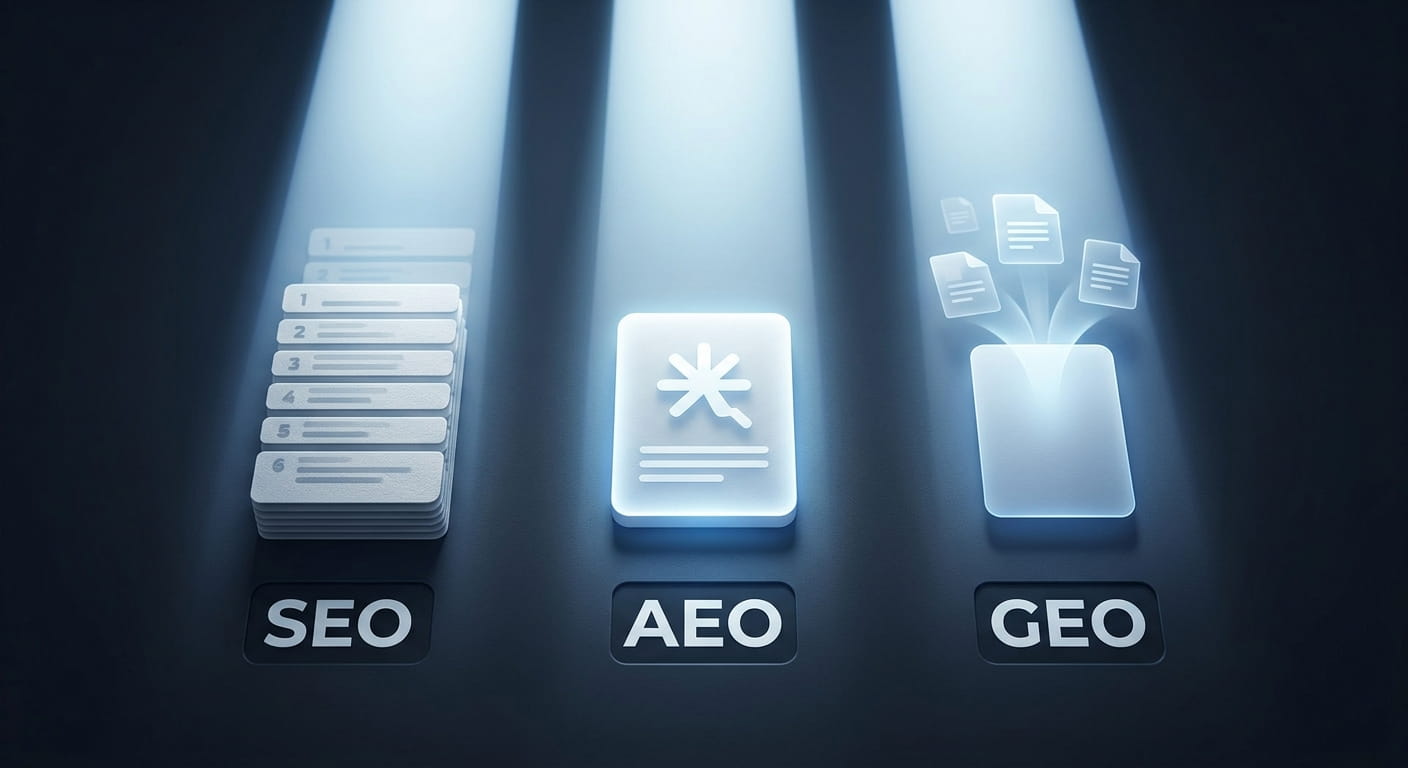
While AEO works with one isolated answer fragment, GEO operates at the level of the entire synthesized answer that the model assembles from several sources at once. Here, the structure of an individual block matters less — what matters more is how authoritative and consistent the whole body of content looks in the model’s “eyes.”
A separate Princeton study on GEO measured which content elements actually raise the chance of being cited, and came up with numbers: adding expert quotes increases visibility by about 41%, adding statistics by about 30%, and links to primary sources by another roughly 30%. The difference is noticeable even at the level of a single sentence. “Automation reduces customer support costs” is a claim the model will cite less often. “According to the company’s COO, implementing a chatbot cut customer support costs by 23% in the first six months, per internal company data” — here there’s a source for the opinion, a specific figure, and that’s exactly what the model tends to trust more.
There’s another principle that’s rarely stated outright: the model trusts facts that are consistently repeated across different sources, and grows wary wherever it sees contradictions. If a company’s website lists hours as “Mon–Fri 9:00 AM–6:00 PM” while its Google Business Profile lists something else, the model loses confidence and may simply leave that detail out rather than risk being wrong. So in practice, GEO means doing the boring but critically important work: keeping the same brand data — name, address, phone number, services, value proposition — consistent across the company’s own website and every external platform, from directories to social media profiles.
Why Does a Business Need AEO/GEO Optimization? Real Examples
The share of people who go straight to generative AI for answers instead of classic search keeps growing every year. A brand that’s absent from these answers becomes invisible to that audience even before it ever opens a regular search results page. Several documented examples show how this plays out for business — from both sides of the shift.

Case Study Results Table
| Company | What They Did | Result | |||
| Schema App (own case study) | added entity linking to their existing structured data markup on the site | visibility in AI Overviews grew by 19.72% | |||
| SEO Works | restructured service pages into a direct-answer format | 20x growth in sessions coming from AI platforms | |||
| Brainz Magazine | filled author expert profiles with entity-rich content | 326% growth in traffic from LLM sources | |||
| Search Initiative (agency client case) | comprehensive AEO/GEO strategy for a client | 2,300% growth in referral traffic from AI platforms | |||
| LS Building Products | implemented structured answer formatting on pages | 540% more mentions in AI Overviews | |||
| HubSpot | kept its pillar-cluster architecture and data-rich content despite declining blog traffic | blog traffic fell 70–80% due to AI “cannibalization,” but HubSpot kept 35.3% share of brand mentions in AI answers — the highest among competitors | |||
| Chegg (a cautionary example) | content stayed text-based and was easily reproducible by AI without needing to cite the source | the company’s stock dropped 49% after ChatGPT started independently solving problems that used to send users to Chegg’s site |
Data taken from a market overview analysis by Whitehat SEO.
The Chegg case deserves special attention, as it shows the flip side of GEO. When content is easy to reproduce without linking back to the source, AI happily uses the information but doesn’t drive traffic or mention the brand. In that situation, optimizing “for citation” rather than just “for text quality” stops being a marketing nicety and becomes a matter of business-model survival.
Will AI Search Replace Google, and Does This Mean the End of SEO?
According to SparkToro, in 2026 more than 38% of Google searches end without a click to a third-party site: the person gets the answer right in the AI Overview, a featured snippet, or a “People also ask” box. At the same time, ChatGPT independently handles 2.5 billion queries a day, and about 65% of them are search-like by nature rather than creative tasks.
Yet the numbers reveal something less clear-cut than it first appears: AI search isn’t replacing Google yet, it’s layering on top of it. According to Similarweb’s analysis (GenAI Brand Visibility Index), even major publishers like Reuters and The Guardian, which generative systems cite often, get less than 1% of their referral traffic from AI platforms. Citations are growing, while direct traffic from them still remains tiny. On top of that, the set of sources cited by Google AI Mode and ChatGPT turns over by 40–60% every month — meaning visibility in generative search is far less stable than a familiar organic ranking position. Notably, Google itself acknowledges the terms AEO and GEO in its official guidance for developers, but insists that from its point of view this is all still SEO, just applied to a new results format. The fundamental requirements — being indexed, having useful content, structured data — haven’t gone anywhere. At the same time, Google explicitly warns against wasting resources on artificial tactics like content “chunking” or creating unnecessary files like llms.txt just for the sake of having them — it gives no ranking benefit.

Frequently Asked Questions (FAQ)
Do I need to create an llms.txt file for GEO optimization?
Google officially states that this file is not yet a recognized standard and gives no advantage in its AI search features. In practice, however, having this file does improve the odds of appearing in AI search.
How long does it take to see the first results from AEO/GEO optimization?
There’s no fixed timeframe: the set of sources cited by generative systems changes by 40–60% every month, so visibility can appear quickly but disappear just as fast.
Do the same tactics work for ChatGPT, Perplexity, and Google AI Overviews?
No. Google relies on the organic top 10, Perplexity relies on source freshness and authority, and Copilot for B2B leans heavily on LinkedIn.
Can you measure ROI from AEO/GEO if direct traffic from AI platforms is still small?
Yes — the metric isn’t traffic but citation frequency, brand mentions, and, if you have a CRM, the impact on lead quality.
Does hiring an AEO/GEO agency remove the need for a classic SEO specialist?
No. AEO and GEO are built on the foundation of classic SEO, so without it you’re only optimizing the top layer with no solid base underneath.
How do you know if AI search mentions your brand and not just competitors?
Regularly check the answers from ChatGPT, Perplexity, Gemini, and AI Overview for your key business queries — this is the equivalent of rank tracking for generative search.




comments