
 МИ ПРАЦЮЄМО ДЛЯ УКРАЇНИ
Contents
- Short answer in numbers
- How often users click through to a site when they see an AI answer
- AI search is taking traffic from websites — but not the way it was predicted
- Why the numbers contradict each other
- Is SEO traffic really disappearing because of AI: how to check your own site
- How businesses can adapt to falling organic traffic
- Should you abandon SEO because of AI search
- FAQ
Short answer in numbers
| What was measured | Result | Source |
|---|---|---|
| Share of visits that ended with a click to a site | 8% with an AI Overview vs 15% without | Pew Research, March 2025 |
| Organic CTR on queries with an AI Overview | 3.19% (January 2025) → 1.31% (December 2025) → 2.36% (February 2026) | Seer Interactive, 2026 |
| Organic CTR on queries without an AI Overview | 2.75% → 3.82% over the same period | Seer Interactive, 2026 |
| Forecast drop in search volume by 2026 | –25% | Gartner, 2024 |
| Google’s position | total click volume is “relatively stable” | Google, August 2025 |
The numbers look as if they contradict each other. In fact they describe different things, and below I break down what each of them actually measures.
How often users click through to a site when they see an AI answer
The cleanest data on how people behave comes from Pew Research. One methodological detail matters: this is not a survey where people describe how they think they search. The researchers analysed the real browsing history of 900 American adults for March 2025. 58% of them got at least one results page with an AI Overview.
The result is a nearly twofold difference between results pages with an overview and without one. And the links inside the AI Overview itself — the sources Google shows as the basis for its answer — were clicked in just 1% of visits.
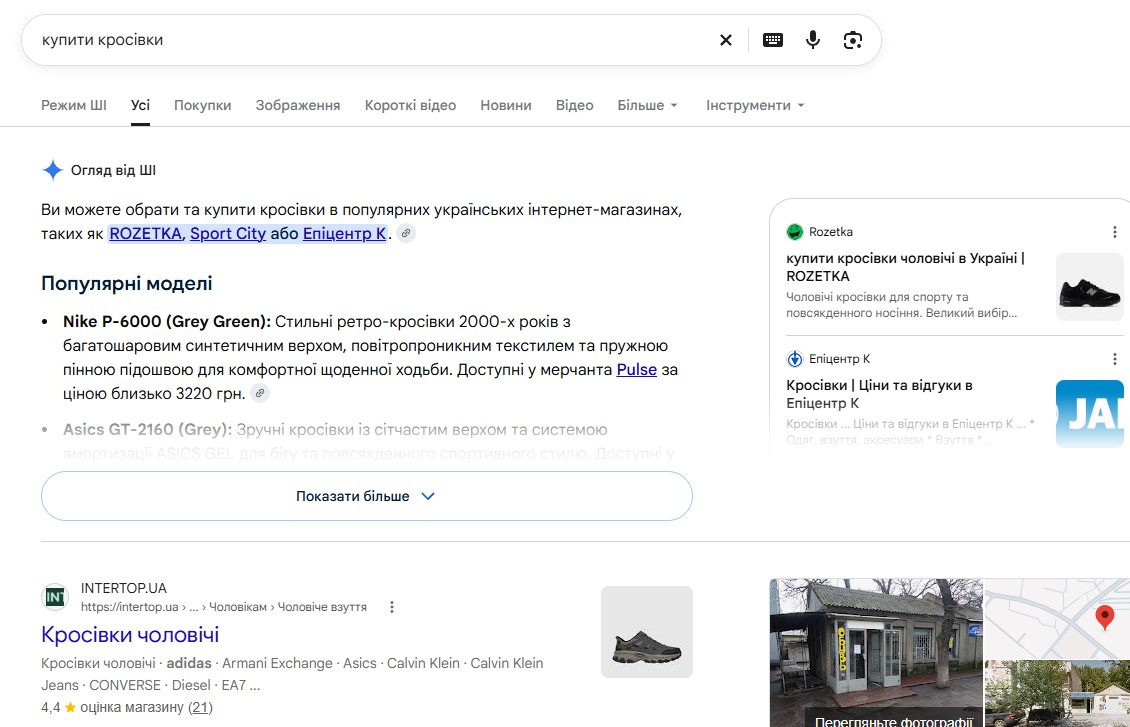
Does this apply to Ukraine? Yes. AI Overviews have been available to Ukrainian users in Ukrainian since spring 2025, and Ukrainian media are already recording the consequences: according to the same Ekonomichna Pravda article, one news site with an audience of around a million unique users a day lost roughly a third of its daily traffic.
For media there is one more important detail. According to Chartbeat, 68% of Google traffic to news sites comes not from Search but from Discover, the recommendation feed. So for publishers, changes in search results are only part of the picture.
AI search is taking traffic from websites — but not the way it was predicted
The forecast drop in search traffic due to AI: what was predicted and what happened
In February 2024 Gartner forecast that traditional search volume would fall by 25% by 2026: people, the argument went, would move to AI chatbots and stop googling.
2026 has arrived, and the forecast did not come true in the form it was made. People did not stop using Google. Something else changed: they stopped clicking through from it to websites. Google built AI answers straight into its results and kept users on its own pages instead of losing them to chatbots.
In other words, the drop happened in clicks, not in queries. For a site owner the consequence is the same — fewer visitors — but the mechanics are different, and they determine what to do about it. What exactly changed with the launch of AI Mode and the algorithm update in May 2026, I covered separately in the article “The death of classic SEO? What the 21 May AI update brought”.
Has the bottom been reached? What the 2026 data showed
The most complete data series right now belongs to Seer Interactive: 53 brands, 5.47 million queries and 2.43 billion organic impressions from January 2025 to February 2026.
| Period | CTR on queries with an AI Overview | CTR on queries without an AI Overview |
|---|---|---|
| January 2025 | 3.19% | 2.75% |
| December 2025 | 1.31% (the bottom) | 3.16% |
| February 2026 | 2.36% | 3.82% |
There are three takeaways here, and the third is the most interesting.
- The drop was sharp. Over 11 months, CTR on queries with an overview fell by almost 60%.
- Then it began to level out. From December to February the figure rose by 85%. The authors themselves are cautious and call this a “new normal” rather than a recovery: the most acute phase seems to be over.
- Queries without an AI Overview became more clickable. There, CTR did not fall over the same period — it rose. So traffic did not vanish from search altogether; it was redistributed.
One more figure from the same study explains where some of the clicks go. Brands cited inside an AI Overview get 120% more organic clicks per impression than brands not cited on the same query. That said, even a cited brand still gets roughly 38% fewer clicks than it would on a query with no overview at all.
Why the numbers contradict each other
In August 2025, Google’s Head of Search Liz Reid stated that total organic click volume is “relatively stable” and that Google is even sending more “quality clicks” to websites — clicks after which the user does not immediately bounce back. The company published no data to support this.
At the same time, independent studies show CTR falling by almost 60%. Is someone lying? Not necessarily. They are measuring different things:
| Who | What exactly they measure | What they see | Why |
|---|---|---|---|
| total volume of clicks from search across the whole web | stability | query volume is growing, so a smaller share of clicks per query is offset by volume | |
| Pew Research | how real people behave on specific queries | half as many clicks | looks at the moment a person sees an AI Overview |
| Seer Interactive | CTR across 53 brands | –60% at the bottom, then levelling out | analyses queries with an AI Overview specifically |
| Publishers | traffic of specific media outlets | from –10% to –30% and more | they live off informational queries, which suffer the most |
All four pictures can be true at once. Total click volume is stable, but the distribution has changed: informational sites are giving traffic away, while queries without an overview and cited brands are picking it up.
For your business this leads to one conclusion: general statistics tell you nothing about your own site. You need to look at your own data.
Is SEO traffic really disappearing because of AI: how to check your own site
When a client comes to me saying “AI ate our traffic”, I neither agree nor disagree until I have looked at Search Console. Because exactly the same graph can come from a completely different problem. For a detailed guide to the tool, see the article “What Google Search Console is”.
Three symptoms in Search Console
- First: impressions are stable or growing, clicks are falling, and average position has not changed. This is the AI effect in its pure form. Your page is in the same place and Google shows it just as often, but people get their answer without reaching you.
- Second: the drop is concentrated on informational pages. “What is” articles, definitions and simple how-tos lose traffic, while commercial pages — services, categories, product pages — hold steady. If every type of page dropped evenly, the cause is most likely not AI.
- Third: your pages have impressions in the “Generative AI” report. Google launched it in Search Console on 3 June 2026, and since 31 August it has been available for all sites under “Performance → Generative AI”. The report shows how many times your pages appeared in AI Overviews, AI Mode and AI features in Discover. The limitation is significant: it shows impressions only, with no clicks, CTR or queries. So compare those pages against the general performance report: if it is precisely those pages where impressions are rising and CTR is falling, the picture fits.
What else can look like “the AI effect”
- A drop in average position. If your position fell from 3 to 8, that is not an AI Overview — it is competitors or a core algorithm update.
- Technical problems. Pages dropping out of the index, an error in robots.txt, broken redirects after a redesign.
- Seasonality. Compare with the same period last year, not with the previous month.
- Changes in Discover. For media and blogs this is a separate traffic source, and its swings are often mistaken for search.
The full procedure for tracking down the causes of a drop is in the article “Website traffic drop: causes and analysis”.
How businesses can adapt to falling organic traffic
If the diagnosis shows the drop really is down to AI, here is what to do:
- Change your success metrics. Clicks are no longer the only indicator. Add impressions from the “Generative AI” report, the share of branded queries and conversions from organic: there may be fewer visitors, but those who do arrive are often already ready to buy.
- Make your pages citable. A direct answer in the first paragraph, tables, figures with sources, a visible author with credentials. These are exactly the fragments an AI Overview picks up as citations. How to do this systematically is covered in the article “What AEO and GEO are”.
- Shift weight towards queries where a click is unavoidable. Commercial, local and comparison queries, and queries involving calculators and tools. An AI Overview can explain what a loan calculator is, but it will not work out a specific loan in place of the bank.
- Invest in your brand. Someone searching for a company by name will click regardless of what the results page looks like. Branded queries are the most resilient part of organic traffic.
- Diversify your channels. Email newsletters, YouTube, social media, partner platforms. Not to replace SEO, but so you do not depend on a single traffic source.
Should you abandon SEO because of AI search
No. And there are three reasons why.
First: AI Overviews are built from organic results. Google forms its answer from pages that are already in its index and rank well. A site with no organic rankings will not get into an AI Overview — so abandoning SEO also means abandoning AI visibility.
Second: cited sites win. As the Seer data above shows, being inside an AI Overview pays off more than sitting in the regular results below it. The competition is no longer just for position but for citation too — but it still starts from that same position.
Third: queries without an AI Overview have become more valuable. There, CTR has risen while competition for the click has stayed classic. For commercial and local queries, ordinary SEO works even better now than it did two years ago.
What has genuinely changed is that SEO has become broader. The task used to be “get the page into the top results”. Now it is “get it into the top results, make sure AI cites it, and build a brand people will search for by name”. That is more work, but not a different profession.

Frequently asked questions (FAQ)
Which types of queries lose the most traffic to AI search?
Informational queries with a short answer: definitions (“what is”), facts (“how many”, “when”), simple how-tos. Branded, local (“near me”) and transactional queries, where the person needs to do something on the site, suffer the least.
What happens to click-throughs when Google shows an AI Overview?
Some people get their answer and close the search: according to Pew, 26% of users end their session after a page with an AI Overview, compared with 16% without one. The rest click either on the sources cited in the overview or on the regular results below it.
Do all sites suffer equally from the AI-driven traffic drop?
No. Media, reference sites and blogs that live off informational queries lose the most. Online shops, service companies and local businesses are affected far less.
Can traffic lost after AI Overviews appeared be recovered?
Partly. Getting clicks on the same informational queries back to their former level is unlikely, but you can get cited in AI Overviews and shift your focus to queries where no overview appears or where a click is unavoidable.
How much traffic does ChatGPT send compared with Google?
Not much so far: by various estimates, referral traffic from AI assistants accounts for anywhere from a few tenths of a percent to 2–3% of a site’s total traffic. Google still delivers the bulk of search visitors.
Can I stop Google from showing my content in AI Overviews?
Technically yes, through the nosnippet or max-snippet directives, but they also restrict your regular snippet in the results, so you will lose some classic clicks too. The Google-Extended directive does not affect AI Overviews in Search: it governs the use of content for Gemini models.
Should I block AI bots in robots.txt?
For most businesses, no. By blocking AI crawlers you remove yourself from the answers of ChatGPT, Perplexity and other assistants, and it will not bring back any traffic from Google Search.
Does AI search affect paid ads on Google?
Less than it affects organic. According to Seer, paid CTR on queries with an AI Overview stayed within 12.9–18%, and it actually fell harder on queries without an overview — from 26% to 21.9%.
Should I wait for things to stabilise before changing anything?
No. The 2026 data already shows the market levelling out, which means the new rules have taken shape. Those adapting their content for citation now are taking a share of clicks from those who wait.




comments