
 МИ ПРАЦЮЄМО ДЛЯ УКРАЇНИ
Contents
- Negative SEO Protection Strategy: Defensive Architecture and Incident Response
- The Nature of Hostile Optimization
- Diagnostic Methodology: How to Recognize Negative SEO
- Technical Analysis of Hostile Tactics
- Protecting Your Website from Negative SEO: Strategic Response
- The Legal Aspect of Digital Sabotage
- New Threats: AI Poisoning and XPIA
- FAQ: Common Questions About Hostile SEO
- Conclusion: Building Immunity
Negative SEO Protection Strategy: Defensive Architecture and Incident Response
Modern search engine optimization requires more than just creating content. Businesses are forced to account for a factor called unfair competition, which manifests in the form of hostile digital attacks. Understanding what negative SEO is exactly is the first step toward building a resilient digital presence. Such attacks target key variables in Google’s algorithms: links, content, and user behavior signals.
The Nature of Hostile Optimization
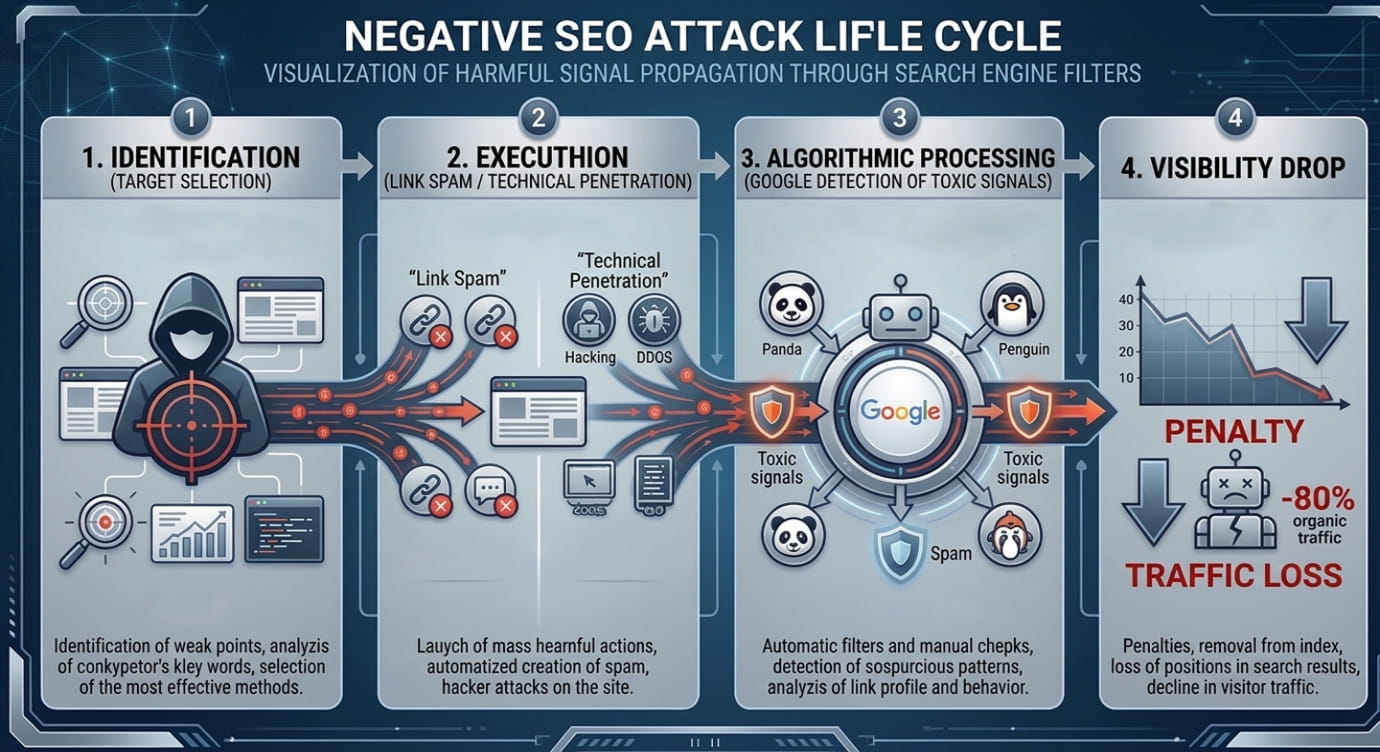
In the current technical landscape, negative SEO is the implementation of “black hat” SEO methods against a third-party website to trigger algorithmic penalties. Unlike traditional optimization, which builds authority, this practice attempts to “poison” the resource’s reputation.
Google’s core algorithms, particularly Penguin 4.0, have evolved to ignore most low-quality signals. However, sophisticated attacks can still cause abnormal degradation in organic visibility. New domains or resources in highly competitive niches remain particularly vulnerable.
Classification of Common Attack Vectors
- Off-page Sabotage: involves the mass creation of entities like toxic backlinks originating from link farms or private blog networks (PBNs).
- Technical Hacking: attackers exploit CMS vulnerabilities to modify the robots.txt file or inject noindex tags.
- Content Theft: automated scripts copy original texts and publish them on high-authority domains to trigger duplicate content filters.
- Behavioral Manipulation: bot traffic creates artificial spikes in bounce rate metrics to signal a poor user experience.
Diagnostic Methodology: How to Recognize Negative SEO
Early detection is the only way to minimize revenue loss. You must establish baseline performance metrics for your site. Any deviation from these norms requires an immediate audit.
Critical Signs of a Negative SEO Attack
A successful attack leaves a digital footprint. Check for these signs of negative SEO attacks in your analytics reports:
- Link Spikes: a sudden increase in the number of referring domains by thousands within a single day.
- Anchor Spam: the appearance of irrelevant or “adult” keywords in the anchor distribution.
- De-indexing: the disappearance of individual high-performing pages without technical changes on the owner’s side.
- Crawl Errors: a massive increase in 404 errors or server timeouts due to intensive crawling by bots.
To distinguish an attack from an algorithm update, it is worth conducting an in-depth analysis of site logs to identify suspicious bot activity. Monitoring User-Agent strings in logs helps determine if scrapers are exhausting your crawl budget.
Technical Analysis of Hostile Tactics
Toxic Backlinks and Link Schemes
Attackers often use “bad neighborhood” donors. These are sites associated with gambling, illegal pharmacology, or pornography. By pointing such links to your resource, they attempt to trigger manual actions from Google’s webspam team.
Anchor spam is a more sophisticated version of this tactic. Instead of random links, an excessive number of commercial keywords with exact matches is used. This creates an unnatural anchor ratio. The algorithm may interpret this as your attempt to manipulate the index.
Content Theft and Scraping
Content theft remains a significant threat. Competitors use artificial intelligence to rewrite articles instantly. If the copied version is indexed faster, the search engine may consider the original page a copy. Using rel=canonical tags and the IndexNow protocol helps confirm authorship.
Attacks on Behavioral Factors
Aggressors direct thousands of bots from countries with high concentrations of botnets. These bots enter a page and leave instantly. The result is a 99% bounce rate. Although Google claims to filter such traffic, a prolonged attack can skew data in the user signal basket and hurt rankings.
| Attack Type | Primary Mechanism | Technical Countermeasure | ||
| Link Spam | Creating thousands of low-quality links via automated scripts. | Regular link audit and use of Google Disavow Tool. | ||
| DDoS Attack | Server overload via denial-of-service requests. | Implementing a Web Application Firewall (WAF) and rate limiting. | ||
| Content Theft | Scraping original text to dilute domain authority. | DMCA takedowns and implementing proper internal linking structures. | ||
| Review Bombing | Posting fake negative reviews on Google Business Profile. | Reporting fraudulent accounts and encouraging reviews from real clients. |
Note: This table summarizes the relationship between hostile methods and professional response strategies.
Protecting Your Website from Negative SEO: Strategic Response
Security is a continuous process of verification and fortification. In case of suspected incidents, follow these protection stages.
Stage 1: Strengthening Infrastructure
Protect your CMS. Use complex passwords. Enable two-factor authentication. If a breach has occurred, it is important to understand what to do if your site has been hacked to prevent the injection of malicious code or hidden redirects. Implementing a WAF helps filter malicious traffic before it reaches the server.
Stage 2: Managing Backlink Profile
Monitor your backlink profile weekly. Services like Ahrefs or Serpstat provide notifications about new domains. Upon discovering a massive influx of spam, prepare a disavow file.
Stage 3: Reputation Protection (SERM)
Review Bombing (negative reviews) targets brand trust. Attackers use AI to generate one-star reviews. To counteract this, monitor your Google Business Profile daily. Report reviews that violate spam policies. Prompt responses demonstrate business activity and care for reputation.

The Legal Aspect of Digital Sabotage
In Ukraine, actions classified as negative SEO fall under the legal definition of unfair competition. According to the Law “On Protection Against Unfair Competition,” any actions contrary to honest trade practices are prohibited.
Legal Consequences in Ukraine and the EU
- Ukraine: Article 32 of the Commercial Code protects business reputation. You can file a complaint with the Antimonopoly Committee of Ukraine (AMCU).
- European Union: The Digital Services Act (DSA) regulation mandates platforms to provide transparent mechanisms for reporting illegal content.
- Liability: Proven facts of attacks can lead to fines and obligations to reimburse costs for restoring digital visibility.
New Threats: AI Poisoning and XPIA
There is currently a rise in AI Recommendation Poisoning attacks. Attackers create documents designed to “poison” the training data of large language models (LLMs). When a user asks an AI assistant about your brand, the model may provide false information.
XPIA (Cross-Prompt Injection Attack) is a way to “hack” or trick an AI agent by inserting hidden malicious instructions into the ordinary data that the agent processes.
For protection, monitor brand mentions on forums and social media. AI models often use these sources to generate real-time answers. The presence of a large volume of positive factual mentions helps neutralize poisoned data.

FAQ: Common Questions About Hostile SEO
How long does recovery after an attack take?
The timeframe depends on the attack type. Technical fixes (removing malware) show results in 2–4 weeks. Algorithmic recovery after a link attack can take from 3 to 6 months.
Do I need to disavow every low-quality link?
No. Penguin 4.0 effectively ignores random spam. Use the Disavow Tool only in case of manual actions or significant drops in rankings linked to a specific spike in links.
Is it possible to identify the attacker?
Determining the specific individual is difficult. However, analyzing site logs allows for the detection of IP addresses and botnet locations. These data points serve as evidence for legal proceedings.
Is negative SEO illegal?
Yes. In most jurisdictions, including Ukraine and the EU, it is considered a form of cybercrime or unfair commercial practice.
Conclusion: Building Immunity
Protecting your site requires a proactive stance. Do not wait for a traffic drop to start monitoring logs and backlinks. Use professional security levels and stay informed about changes in Google’s algorithms.
Quality content and strong user experience remain the best defense. As search engines get smarter, they prioritize sites with genuine authority. Focus on building a brand that users trust, and the impact of harmful signals will naturally diminish.
If you find that your site has suddenly stopped appearing in search results, rankings have dropped, or you have noticed other negative signs described in this article, please contact professionals, such as the internet marketing agency Outsourcing team, to resolve the problem.




comments